
 Reasons for and Consequences of the Exacerbation of Situation in Russia
Victor Hvozd
Doctor of Military Sciences
Recently, one of the determining factors influencing the development of events around Ukraine is the complication of the internal situation in Russia with the approach of parliamentary elections in the country in September of 2021. Despite the fact that the elections in the Russian Federation have been mostly formal since the 2000s, today this situation is undergoing serious changes.
According to Western experts, the reason for this is the deepening crisis of Russia’s politico-economic system, which was built by V. Putin on archaic Soviet practices and cannot adapt to dynamic changes in the world. At this, the catalyst for the crisis in Russia was Moscow’s moving to confrontation with the West and, in particular, its attack on Ukraine.
|
…The catalyst for the crisis in Russia was Moscow’s moving to confrontation with the West and, in particular, its attack on Ukraine… |
As is well known, such a policy has led to aggravation of Russia’s relations with Western countries and international organizations; restriction of its access to world markets, loans and modern technologies due to sanctions; deterioration of the Russian economy; increasing social tensions in the country and declining of the authority of the Russian leaders. All these problems were further exacerbated in 2020 due to the COVID-19 pandemic and falling world oil prices, which caused critical damage to the Russian economy. First of all, it affected the Russian oil and gas sector, which has lost more than 40 % of average revenues.
At the same time, according to a number of Russian political scientists, disagreements between various political and oligarchic groups around V. Putin have also intensified. In the current situation in Russia, the main reasons for such disagreements are the struggle for the access to the budget and reserve funds, redistribution of the most profitable assets, as well as determining the ways to overcome the country’s economic problems.
A separate factor in the confrontation of the ruling elite of Russia is the intensification of the struggle between the leaders of different groups to strengthen their political positions up to the highest level of Russian power. Today the mentioned issue is quite actively discussed by the world expert circles. At this, the possibility of V. Putin’s illness is noted, as a result of which he loses the capability to effectively govern the country and counteract his internal rivals. For example, such an estimate was made in the “White Book” of the Foreign Intelligence Service of Ukraine.
|
…The main participants in the internal confrontation in Russia are the representatives of the power and economic blocs of the Russian establishment… |
As before, the main participants in the internal confrontation in Russia are the representatives of the power and economic blocs of the Russian establishment. At present, the increase in the number of information leaks to discredit each other is a reflection of the intensification of the struggle between them.
In particular, at the end of last year, some Russian media, close to the country’s security services, made efforts to provoke a scandal over the proposals of the RF Ministry of Finance to reduce defense spending by about 30 %. In this way, the “siloviki” tried to influence the Russian oligarchs, who sought to redirect budget funds from defense sphere to the needs of their own businesses. In this confrontation, the main opponent of the oligarchs was Russian Defense Minister S. Shoigu, who is part of Putin’s closest environment.
During the same period, an “information attack” was inflicted on V. Putin himself by spreading information about the involvement of his family members in the fraud with the assets of Russian energy companies. The organizers of such an attack were not openly named, however, according to some evidences, meant were the owners of the largest petrochemical company in Russia — Sibur, in relation to which such manipulations were carried out.
The existence of contradictions in Putin’s environment was also publicly acknowledged by the Press Secretary of the Russian President D. Peskov. He pointed out the attempts of certain forces both, inside Russia and abroad, to use such information attacks for their own purposes, including to destabilize the situation in the country.
In fact, all this is fully true. This was evidenced by protests in Russia caused by the arrest and conviction of one of the leaders of the Russian opposition, A. Navalny. Unlike similar protests that took place in previous years (starting in 2017–2018 due to the deteriorating socio-economic situation in the country), the current ones had a number of fundamental peculiarities.
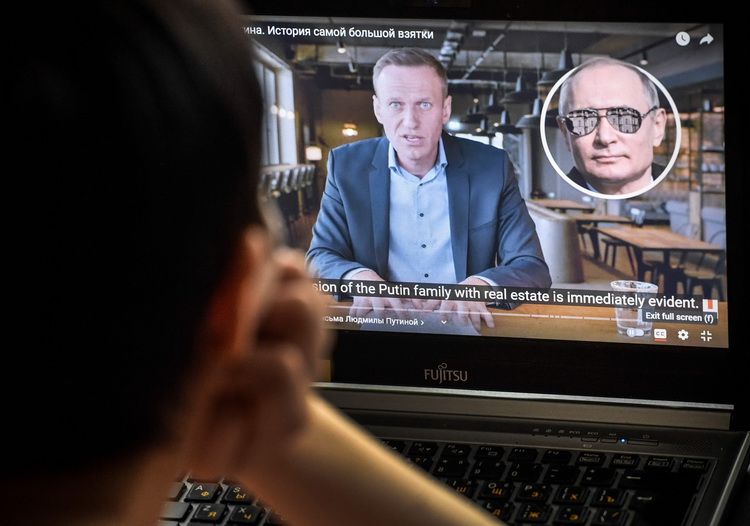 Firstly, it is an effective organization of actions in support of A. Navalny with a carefully planned scenario. For example, since the autumn of last year, a number of effective steps have been taken, which included: drawing public attention to Navalny’s poisoning, of which the Russian secret services were accused; conducting an active information campaign to discredit the Russian government and personally V. Putin (including by the resonant film about his corruption and personal residence on the Black Sea); creation of central and regional campaign headquarters for the preparation of rallies and demonstrations and devoting them to specific resonant events.
Secondly, the massive participation of A. Navalny’s supporters on almost the entire territory of the country from Moscow and St. Petersburg to Khabarovsk and Vladivostok. In general, the number of protesters is estimated at 150–200 thousand people. At this, such actions in the annexed Crimea were the most significant, which showed the lack of unanimous support for V. Putin among the locals (who are allegedly grateful to him for the “accession” of the Peninsula to Russia);
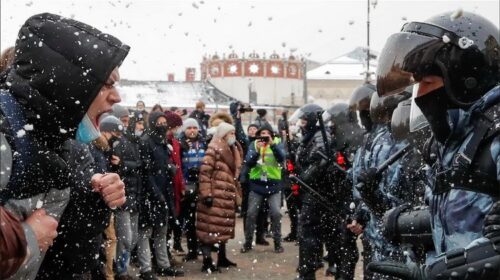
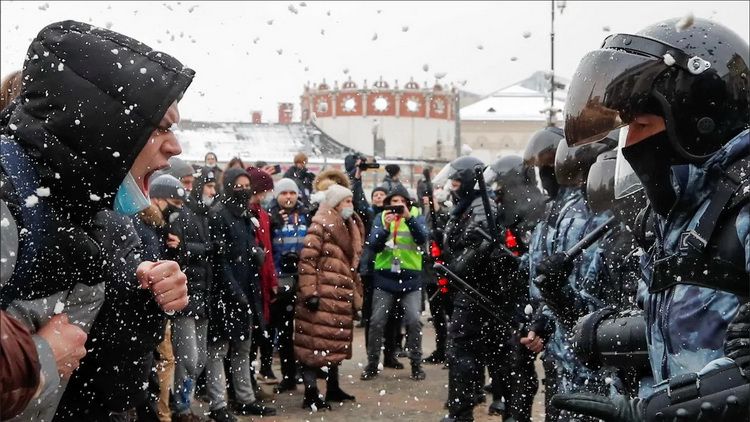
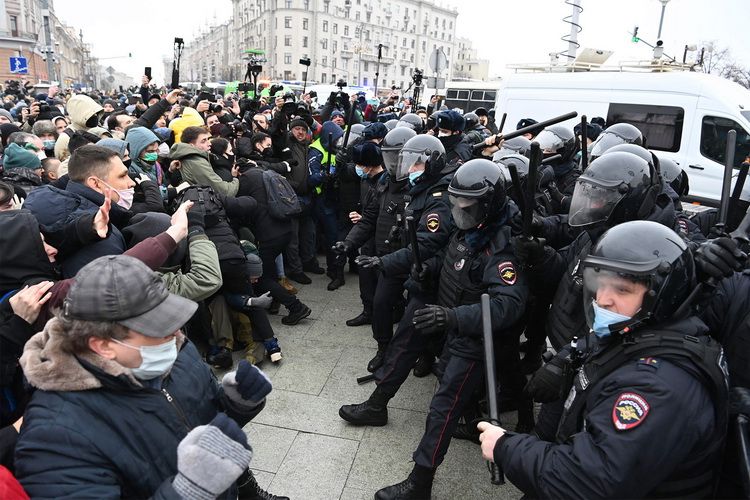
Thirdly, the radicalization of the moods of the protesters, who move from passive actions to demonstrate their problems or demands to the authorities, to clashes with the police and other security forces. At this, in a number of cases (in particular, in St. Petersburg), the demonstrators managed to push the law enforcement forces and made them move to the defense.
 |
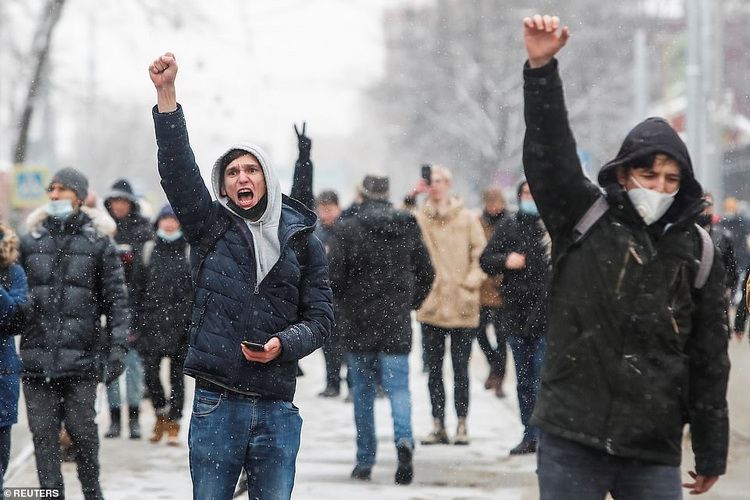 |
Fourthly, the growing number of young people taking part in protests against the oppression of democracy in Russia. In fact, they, as the most dynamic stratum of the society, are the main opponents of Putin’s regime. Besides, young protesters are the most aggressive, and this is a side effect of the Kremlin’s national chauvinistic ideology. In fact, imposing aggressive attitudes to other countries (Ukraine included) results in the vector of aggression turning to Russia itself.
Fifthly, the orientation of protests against V. Putin himself. Thus, while earlier the demands of the participants of rallies and demonstrations were mainly of an economic nature, now they have moved to the political sphere. The beginning of this trend was evidenced by the protests of the population in Khabarovsk in the summer and autumn of last year after the arrest by the federal center of the governor of the region S. Furgal. Now such political demands are spreading all over Russia.
Based on this, V. Putin is no longer perceived by people as a “good tsar” who stands above the “bad boyars”, but is considered responsible for Russia’s problems. This is confirmed by the results of independent opinion polls (in particular, by the Levada-Center), which show an unprecedented drop in Putin’s rating to the lowest level since his tenure in power — 29 %.
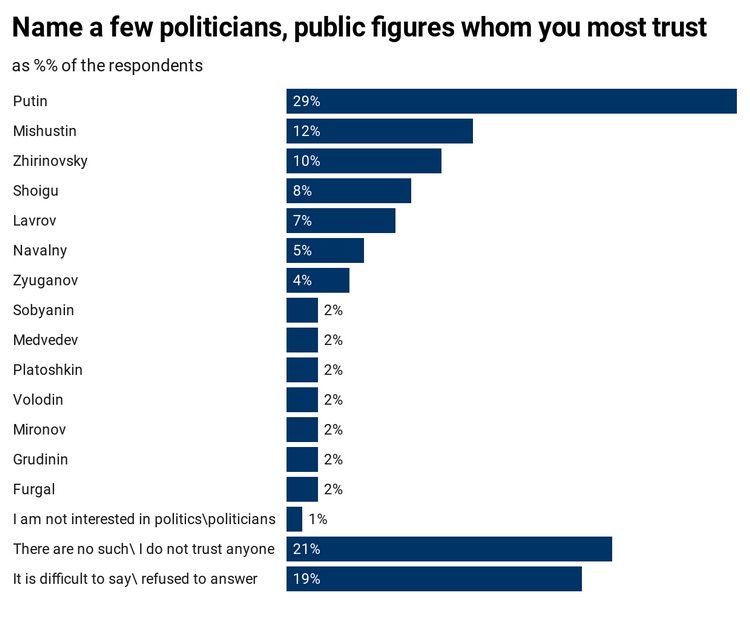 |
| Presidential ratings: the results of a poll conducted by the Russian Levada-Center |
Against this background, another illustrative fact was the confusion of the Kremlin, which not only failed to predict the above-mentioned situation, but could not prevent its consequences either. In particular, the actions of the Russian special services related to the poisoning of A. Navalny became quite unprofessional. Besides, despite all their power, they could not prevent the circulation of the film about V. Putin, which has been seen by almost the entire adult population of Russia. In a similar way, Russia’s special services could not stop the spread of protests of Navalny’s supporters.
V. Putin’s reaction to all these events is also inadequate. Thus, instead of an open dialogue with the Russian nation, he confines himself to formal speeches in which he conceals Russia’s problems, asserts non-existent achievements, and avoids mentioning Navalny’s name. According to political scientists, this once again confirms Putin’s losing the capability of objective perceiving the realities of the modern world, including due to his age and health condition.
At the same time, experts draw conclusions about possible involvement in Navalny’s supporters’ protests of Putin’s rivals from the ruling elite, who are trying to create conditions for seizing power. This explains the miscalculations in the actions of the Russian leadership.
In addition, indicative is Russian media’s spreading allegations about possible attempts of the US and British secret services to organize mass riots in Russia in September of 2021 under the pretext of the falsification of the parliamentary elections. According to the media, the aim will be to remove V. Putin from power by the methods of Ukrainian “Maidans”.
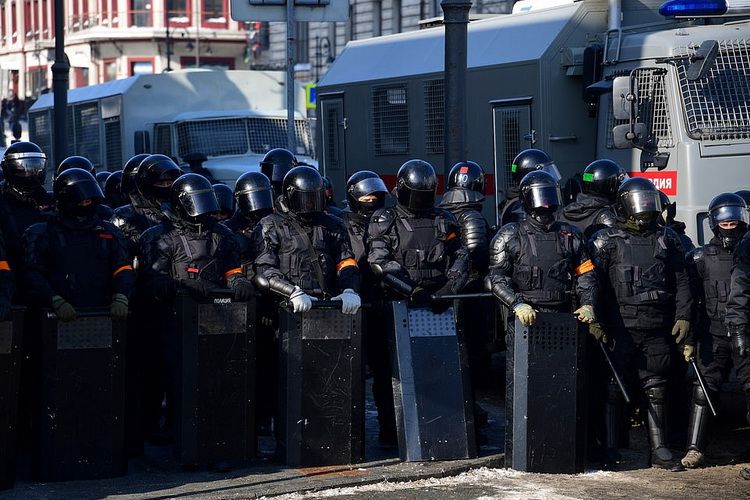
Of course, these estimates and forecasts are somewhat exaggerated. Today, the Putin regime still has sufficient resources to maintain its power, including to suppress the opposition protests. Moreover, V. Putin and his associates are stepping up measures to counter these trends. This was aimed at amending the Russian constitution, which provided for the strengthening of the power vertical in the country, as well as creating additional tools to neutralize the opposition.
 |
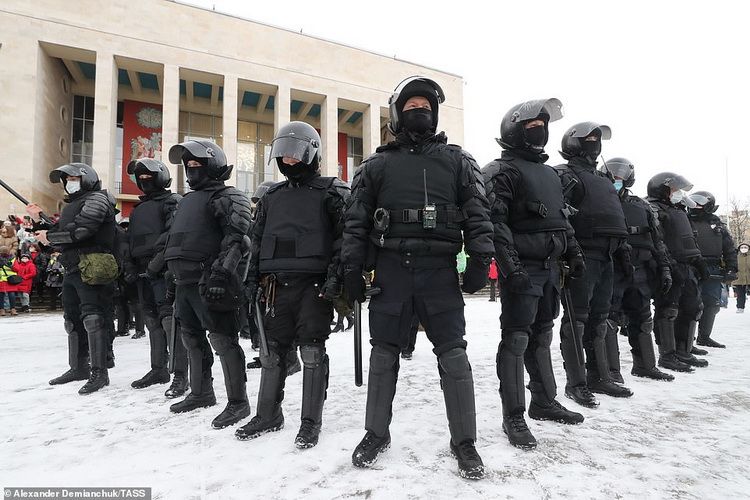 |
| Today, the Putin regime still has sufficient resources to maintain its power | |
In particular, on the basis of this, countermeasures were organized to suppress the protests of A. Navalny’s supporters, especially after his latest arrest. At the same time, efforts are being made to ensure the ruling United Russia party’s victory in the upcoming parliamentary elections. In general, they include a wide range of measures, ranging from restricting access to elections of the opposition, to establishing full control over election commissions of all levels and election observers.
However, all this in no way guarantees the stability of Putin’s regime. Thus, Moscow is already beginning to lose influence in the regions of the country, as shown by the victory of the Liberal Democratic Party and the Communist Party of Russia in local elections in the Far East and in a number of other regions and territories of Russia. In fact, this created the basis for mass and long-lasting protests in Khabarovsk, with which the federal center still can’t cope.
Besides, according to most economists, in 2021 Russia’s economic problems will intensify, which will lead to a continuing trend of falling living standards. In turn, this will expand the base for opposition actions, including organization of mass anti-government protests.
As a result of these processes, the situation in Russia may indeed enter a state of deep crisis with unpredictable consequences. At this, the possibility of Russia’s disintegration following the example of the Soviet Union is not ruled out. Today, such developments are already considered by the United States, NATO and Europe.
In particular, due to the commissioning of new liquefied gas terminals, Europe has already lost its gas dependence on Russia. At the same time, Russia has lost the energy leverages on the EU, as it did more than once after the Orange Revolution in Ukraine.
|
…Much more dangerous for Europe is the threat of a civil war in Russia and the possibility of Moscow losing control over Russia’s nuclear weapons… |
Much more dangerous for Europe is the threat of a civil war in Russia, as happened after the collapse of the Russian Empire in 1917 and in the post-Soviet space after the disintegration of the USSR. At this, the greatest concern of the West is the possibility of Moscow losing control over Russia’s nuclear weapons.
Counteracting such threats is one of the goals of the US and NATO measures to create a sanitary cordon against the Russian Federation, at least on the European direction. Such measures include strengthening the US/NATO military presence in Central and Eastern Europe, as well as deploying their missile defense systems in the region.
By the way, the deployment to the Black Sea of two US Arleigh Burke-class guided-missile destroyers in January–February of 2021 (against the background of the complication of the situation in Russia) was called by the command of the Sixth Fleet of the US Navy as a test for the air and missile defense systems of the United States/NATO in Europe.
|
…The aggravation of internal problems in Russia opens a “window of opportunity” for Ukraine. This applies to both the European and Euro-Atlantic integration of our state, and the solution of the Donbas and Crimean problems… |
However, such forecasts and prospects are again mostly hypothetical. At this, even in case of a change of the ruling power in Russia, its policy towards Ukraine is unlikely to improve. Evidence of this is the position of the leaders of the Russian opposition (including A. Navalny), most of whom have national chauvinistic sentiments.
At the same time, the aggravation of internal problems in Russia, one way or another, opens a “window of opportunity” for Ukraine. This applies to both the European and Euro-Atlantic integration of our state, and the solution of the Donbas and Crimean problems.
In particular, Moscow has actually come to terms with the deepening of cooperation between Ukraine and NATO, which was previously a “red line” for Russia. As for the Donbas and Crimea, Russia has also moved from offensive to defense policy and rejects Ukraine’s initiatives to resolve these problems.
At this, Ukraine gets a real opportunity to strengthen its position in the confrontation with Russia.


